Proud Member since 1998

Thursday, July 11, 2013

Orangeberry Book of the Day - Amidst Traffic by Michel Sauret

Three Straws

The same dream kept coming for Eli, and it was terrible. The worst part about it was the faces of children who chased him through cobbled streets beneath dilapidated, stone-faced buildings of a foreign country. In the dream, he kept looking back over his shoulder as he ran. Their faces looked as if someone had taken a box cutter and carved at their lips, noses and eyelids. Tiny monstrous faces. Eyes wide and nostrils flared. Their cut-up lips revealed small, gnashing teeth.

They looked so much like his father’s drawings.

Eli couldn’t take another night of those faces. So he stood outside behind his trailer because he didn’t know what else to do. He didn’t want to go to sleep.

He stared at the dark forest for a while, but then he imagined those children hiding among the trees. So he looked up at the sky and stared a while longer at the stars. Time simply passed, but eventually even in the sky he could connect the dots and see those carved-up stares.

“Oh my God,” he said, covering his face with his hands. “Let it stop.”

Impulsively, he hurried to the shed. He needed to put his hands on something. The first thing he saw was a shovel, so he grabbed it. He walked a few hundred feet into the open stretch of land behind his trailer and stabbed the dull blade into the earth.

It felt good.

The blade went in. The ground was soft. So he pulled out a chunk of dirt and stabbed the earth again. The soil was moist and easy to dig. A few more of these, he thought, and he would be okay. He just needed to work it out. He just needed to release whatever demons plagued his mind. If any alcohol had been in the house he might have washed those demons away with booze, but he rarely drank and there were no liquor stores open this late for miles. Living out in the countryside of Oklahoma relaxed him, but even out here he couldn’t hide.

Don’t think of it. Keep digging. Keep working.

He dug and flung chunks of dirt across his body and over his shoulder. He thought that after a few shovelfuls, the labor would make him exhausted. Then it would be okay to sleep. Maybe if his body ached, he would pass out from exhaustion and there would be no dreams. He didn’t know how this worked, but that seemed right.

After an hour, he had only built up momentum. Now he was consumed in his digging. Sweat formed a paste with the dirt and glued to his skin from the neck down. It wasn’t until three in the morning that the pains finally caught up to him. In a few hours he had to start his morning shift at the diner. He finally paused, looked around and realized he had dug a hole as wide as a kiddy pool four feet into the ground.

“Good,” he said, although it wasn’t.

What would he do next; fill it back up?

“No,” he said, “Leave it.” He said this as though he needed to answer the question. Maybe I’ll fill it later. It will give me something to do.

He slept for two hours that morning and dreamed nothing.

The diner was a few miles from the Texas border. When he showed up for his shift, his muscles felt like knotted ropes of twine. He grabbed an apron, tied it around his waist and stood at the grill in the kitchen. Food orders came immediately. He didn’t realize how many muscles he used to simply grill breakfast orders until that moment. Pouring pancake mix with a ladle made his arm feel twisted against his will. Every step he took shot a flare of pain from his heels up.

He washed down a mix of pain pills he found in the first-aid kit and fueled his mind with coffee as the morning wore on. He regretted sleeping only two hours. In the midst of a breakfast rush, it became harder for him to focus on orders. Cynthia, one of the waitresses, had to send two plates back to him because the sausage was burnt on one and he forgot to include cheese in the omelet on the other.

“What in the hell’s wrong with you this morning, Eli?” she asked him. “This ain’t the time to be messin’ up orders. It is too damn busy right now, okay? I ain’t made tips since you came in, and haven’t stopped apologizing to customers since.”

After a week of this—mindless digging, no sleep, then coming to work half-dazed, feeling broken and sore—the diner’s manager still had no heart to fire him. He was a good kid. Didn’t talk much, but up until now had always been a good worker.

Instead she asked him, “Would it help to put you on night shift, honey? You’ll have to work the counter, too, and you won’t get no sleep until the morning risers come in, but it’s ‘tween that and lettin’ you go.”

“I’ll switch,” he said, and although his voice was a whisper, his eyes were desperate with relief. Anything to work through the night, he thought. Anything to avoid the faces.

Eli wasn’t good with people. He could never get a hang of the small talk the other waitresses mastered so effortlessly. Most of the truckers who came through told stories of drunken hitchhikers, cross dressers and visitor centers no one should ever visit after dark. Eli listened, nodded on and served their midnight breakfast orders.

“Y’ain’t gonna make no tips if all you do is bob that noggin’ of yours. Gotta converse with the fellas,” Rosie, the manager, whispered in Eli’s ear as he grilled some hash.

“Not worried about tips all the much. ‘Need just enough to get through.”

It was true. He didn’t need much. The land he lived on was paid for. So was the trailer. He had no girlfriend. No hobbies. No other desires. Wasn’t a boy with many complexities. Just lived by himself in a single-wide big enough to feel like he was sleeping inside a box. The land was his after his father passed on.

At one point he had wanted to go to Bible college and become a preacher just like his daddy. But those felt like boyish thoughts now. He was twenty-two, and somehow that made him feel very old.

“Alright then,” she said.

But then a man walked in with a strange aura about him. There was a tenderness to the man’s walk. A careful step, as if he didn’t want to disturb the air around him. He was an older gentleman with a glow to his face that provoked a feeling of friendliness in Eli. It was a strange, strange sensation.

“How are you doing young man?” he asked, but sounded as though he actually expected an answer.

“I’m quite fine, sir.”

The old man’s face held lines, but his eyes didn’t sag.

“I’ll take your finest roast. Straight black,” he said.

Eli rushed to fill him a cup, wondering if this oil-resembling crud would satisfy the man. He brought over the mug, felt the need to introduce himself, but instead found the man joking around with Rosie, asking about the kids, complimenting her new hairdo.

Eli waited a while to see if the opportunity came up to interject. What in the hell’s wrong with you, man? He’s just some guy old enough to be your daddy’s father. Just some customer with stories as any other.

The man might have been seventy, but he made gestures with his hands and spoke like he had the energy of a man half his age. He had a gentleman’s face, that of someone who might never utter an insult at anyone. He wore a small red rose was pinned to his vest, like a corsage.

“Will there be anything else, Sir?” Eli asked after refilling his third coffee.

“Sure is. Could I kindly have three straws?”

“I’m sorry?”

“Straws. Three of them, please.”

“Three?”

The man nodded.

“Straws?”

Nodded again.

“What for?”

“Just three straws, and I’ll be on my way.”

So he grabbed the straws and handed them to the man.

The man nodded, smiled and went on his way.

Buy Now @ Amazon

Genre – Short Stories / Literary Fiction

Rating – PG13

More details about the author & the book
Connect with Michel Sauret on Facebook & Twitter

Wednesday, July 10, 2013

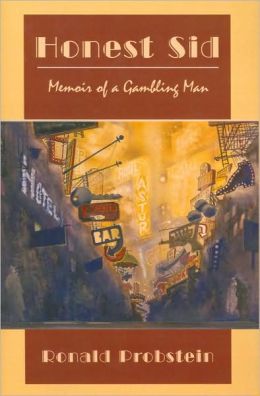
Orangeberry Book of the Day - Honest Sid: Memoir of a Gambling Man by Prof. Ronald Probstein

1 Play Ball

Take me out to the ball game, Take me out with the crowd Buy me some peanuts and cracker jack, I don’t care if I never get back, Let me root, root, root for the home team, If they don’t win it’s a shame

For it’s one, two, three strikes, you’re out, at the old ball game. Jack Norwich and Albert Von Tilzer (1908)

“Ronald! Ronald! Get up!” The voice was that of my mother trying to awaken me, the place a run down hotel near Times Square at about two or three o’clock in the morning. I was a good-sized five-year-old, so it took a great deal of pulling before she finally managed to get me out of bed. She threw some clothes on me and, with muted cursing, dragged me toward the fire escape with one hand while holding a suitcase in the other.

As it turned out, there was no fire; our unusual exit was the result of being considerably behind in the room rent. In the Depression days of 1933, when residents were in arrears, it was common hotel practice to lock the room door from the outside at night. That way, no one could leave undetected with his or her belongings.

Scrambling through the window onto the fire escape, my mother swore again as she caught her high heels in the grating. She managed to get her shoes off and, holding the shoes and suitcase in one hand and grasping me with the other, she led me down a couple of stories to the lowest level.

By then, I was fully awake. Peering down I saw a dark, menacing chasm. In reality, we were only about ten feet above the sidewalk of a back alley where the most frightening aspect was a jumble of garbage cans, but I was certain that fanged, wolf-like creatures were hiding in the dark shadows below, waiting to jump out and attack us when we reached the bottom.

It was then that I heard my father in a stage whisper calling, “Sally, have you got the kid? You okay?”
“Yes, damn it, but I can’t get the ladder down. The latch is stuck.”
My mother struggled to release the catch that would allow the ladder at the bottom of the fire escape to slide to the ground. My fears heightened as I watched my father scramble around the alley below. He picked up a discarded wooden crate that he carried over and put down underneath the fire escape. Standing on it, he said, “Pass me the kid.”
After pulling me into his arms and setting me down, he helped my mother climb down. For a moment the three of us stood gathered together on the pavement amidst the rubbish and cans, a family portrait of an American scene that Norman Rockwell never captured on the cover of the Saturday Evening Post.
My father possessed an optimistic disposition that no amount of adversity could dampen. What little money he brought in he made by taking bets on the horses. Unfortunately, he was not very successful. Like most bookmakers, he assumed that the customer is usually wrong. Acting on that assumption, he all too frequently took a bet he couldn’t cover. If the horse finished in the money, my father sometimes had to scramble to come up with the payoff.
Known around Times Square as “Honest Sid,” he followed the aphorism, “To live outside the law you must be honest”—since the penalties for dishonesty in the underworld can be far more severe than those meted out by the justice system. Whether or not his nickname was totally accurate, my father had no desire to find himself with broken kneecaps for welshing on a gambling debt. Skipping out on a hotel bill, though, was something else again. He looked upon it as a game of wits in which he was just one of many players.
That night my father was in his usual good humor as we walked hand in hand a few blocks to a rooming house where he had found temporary lodging. He turned to me and, despite my mother’s glare, said, “See kid, I told your mother it would be a cinch.”
My father was born in New York City on November 7, 1894, the next-to-youngest of twelve children. His father, my grandfather Nathan, had emigrated in 1868 from Austria at nineteen to seek his fortune in America, mainly at the card tables, staking himself with the money he made from his occupation as a jeweler. In 1876, Nathan married Rebecca Breiter, an extremely pretty young girl of seventeen who lived with her family on Delancey Street, a Jewish ghetto in New York’s Lower East Side.
The tone of my grandparents’ marriage was set early on when my young grandmother was expecting their first child.
“Becky, pack your bags. We’re leaving New York and going to England in three days. See, I got the tickets!” my grandfather exclaimed, waving them in his hand as he burst into their little flat. “Cousin Morris has that big store in Manchester—he’s written me and they could use a jeweler,” he continued.
“But why now, in such a hurry? And England—when I’m already five months along?” my grandmother blurted out.
“Please, don’t ask questions,” was the imploring reply.
All of the necessary arrangements were made with the help of my grandmother’s family, and within a few days they sailed for Liverpool on the Adriatic, one of the White Star Line’s express steamships that traveled the Great Circle route of the Atlantic from the United States to England. These iron-hulled ships were powered by steam-driven screw propellers but were still rigged with tall masts and canvas sails. On board, the first-class passengers were pampered in plush staterooms and a grand saloon furnished with marble fireplaces and plump velvet chairs and settees.
By contrast, my grandparents’ berth was a bare wooden stall lit by oil lamps with a canvas sleeping cot that folded away so a table with attached seats could be lowered for meals. In “the cellar on the ocean” there were two toilets for every hundred passengers, but my grandparents remembered the worst part of the ten-day voyage in steerage as the foul smell leaking from the engine room. The smell, the incessant noise of the screw, and the roll of the ship in heavy seas combined to make for a difficult journey, especially for a young woman pregnant with her first child.
During their voyage, my grandfather finally told his wife the real reason for their abrupt departure. He had lost heavily at cards and then borrowed money from loan sharks to cover his debt. In short order, he lost the borrowed money and realized that he had no chance of repaying the loan. Fearing for his safety, he decided to flee to England. Not only did a job await him, but most importantly, he would be beyond the reach of the loan sharks.
“Don’t worry, Becky. We’ll go back soon as it’s safe,” was the only consolation he could offer his wife.
They arrived in Manchester where their first son, Jacob, was born. The following year my grandfather felt the heat was off and he kept his promise to his wife. The family returned to New York City, moving into the same tenement on Delancey Street where Rebecca’s family lived. They were extremely fortunate to get a small four-room flat facing the street, although only the front room received direct light. They also had the luxury of a common indoor toilet in the narrow hallway. In case of fire, however, there was little chance of escape because the narrow stairways and fire escapes were crowded with furniture and boxes. In the hot summer months the fire escapes were also overflowing with tenants seeking relief from the fetid air indoors.
At the time, the English novelist Arnold Bennett remarked during a visit to New York that the Lower East Side “seemed to sweat humanity out of every door and window.” Factories, garment shops, laundries, and cigar shops crowded the rows of densely-packed dark tenements. Small shops and pushcarts lined the streets; the teeming throngs and cacophony of vendors hawking their wares gave it the feel of an aviary caged by tenement walls.

Buy Now @ Amazon

Genre – Biographies & Memoirs

Rating – PG13

More details about the author & the book

Connect with Prof. Ronald Probstein on Facebook & Twitter

Tuesday, July 9, 2013

True Love’s First Kiss, The Queen of the Realm of Faerie Books 1-3 by Heidi Garrett

images (3)

***This is NOT Book 4 This is a compilation of Books 1-3***

In the Enchanted World, true love’s first kiss is magic.

Nandana’s Mark, Book 1: When two half-faeries–Melia and her younger sister–are cursed under dreadful circumstances, true love’s first kiss is the remedy.

The Flower of Isbelline, Book 2: Nothing but true love’s first kiss can save Melia’s younger sister from blind ambition and ruin.

The Dragon Carnivale, Book 3: Melia must choose the freedom she cherishes or true love’s first kiss–and a relationship that promises to secure her place in the Whole.

The Queen of the Realm of Faerie is a fairy tale fantasy series that bridges the Mortal and Enchanted worlds. The main character, Melia, is an eighteen-year-old half-faerie, half-mortal.

When the story opens in the first book, Melia is troubled by her dark moon visions, gossip she overhears about her parents at the local market, and the trauma of living among full-blooded faeries with wings–she doesn’t have any.

As the series unfolds, the historic and mystical forces that shape Melia’s life are revealed. Each step of her journey–to find the place where she belongs–alters her perceptions about herself, deepens her relationships with others, and enlarges her world view.

True Love’s First Kiss is a compilation of the first three books in this ongoing series.

Buy Now @ Amazon

Genre – Fantasy

Rating – PG

More details about the author

Connect with Heidi Garrett on Facebook & Twitter

Blog http://www.heidigwrites.blogspot.com/

Orangeberry Free Alert - Will To Love by Miranda P. Charles

Will To Love - Miranda P. Charles

Amazon Kindle US

Amazon Kindle UK

Genre - Contemporary Romance

Rating - R

3.3 (16 reviews)

Free until 13 July 2013

Clarise Carson was desperate to keep her newly-engaged sister from playing matchmaker at her very own engagement party. She couldn't think of anything more embarrassing than have her sister's guests see her as the loser in love who couldn't find "The One" so she dragged a handsome friend to be her "pretend" boyfriend for the night. 

Will Matthews attended his friend Rick's engagement party for one reason - to meet Rick's future sister-in-law, the writer for Lifestyle by Design magazine, in the hope that he could have an article published for his boutique travel agency service. He knew Rick had plans to introduce him to some single girl at the party but he laughed it off. He had no desire whatsoever to be in a relationship with any woman who would want commitment. He was far too focused in building his business to the success he dreamed.
When Will and Clarise met, sparks flew and there was an instant, undeniable attraction between them. With Will, Clarise found herself wanting to bury demons from the past. But Will knew what he wanted - and it wasn't a relationship.
How could Clarise stop her old wounds from opening up and bleeding again? And how could Will learn to embrace the one thing he didn't even know he wanted?

*****

Each book in the Lifestyle by Design series is a complete stand-alone novel that would give you enjoyment on its own.  However, to maximise your experience of the series, the author recommends reading them in order.

Will To Love is the first of three beautifully passionate, steamy love stories from the Lifestyle by Design series.

This book is for adults only.  It contains hot sexual content.

Orangeberry Book of the Day – Tainted Waters by Maggie Thom

Chapter Seven

“We need to come up with a plan. It’s time to make a move.” He knew what the answer was going to be. It was the same one he’d been receiving for almost eighteen months. At some point those higher up had to get it.

“We’ve had this conversation. We have the opportunity to bring down a lot of players. A lot. So I’m not going to let you screw this up just because you’re getting a little antsy. Stick with it. Keep doing the job you were hired to do. Suck it up, in other words. This is too big for you to mess up now. You’re in there. The last two guys didn’t make it out. I’d hate for the same to happen to you.”

After a few more minutes of lecture about how important this operation was, he hung up before his asshole contact could say anymore. Like the guy would put his life on the line. Throw away all his morals, just to catch a bad guy.

He flung his cell phone across the small, flea-infested motel room and watched as it splintered into twenty pieces. It wasn’t exactly how he was supposed to get rid of his burn phone but it felt good. His boss, well, on this assignment anyway, was just looking to get his name in lights. To retire after having brought down one of the biggest dope rings in the area, maybe even the country. He was focussed on what he’d get out of it. His men, it seemed, were expendable. It was bring the son of a bitch down or die trying.

And all I stupidly want is an end to this. An end to the drugs. The killing. Driving his hand into the tattered wallpapered wall, he felt a little bit of satisfaction at the hole he’d left. Especially since he imagined it was a certain someone’s face. His boss may want him to continue as planned. To keep playing the game. But he’d had enough. He was in, tight. Had been in for a long time, but it was now time to figure out who, all the people involved were. He had some names but he’d made sure not to do too much digging. He had not wanted Ozz to be suspicious of him. But the time was now to figure out who they all were. At this point, all he wanted to do was to bring down the man who was as cold and as ruthless as they came.

He grabbed the pieces of his phone and strode out, distributing the small chunks in ten different dumpsters before heading back to the lake.

~~~~

Keegan rode alone up to the fifth floor. The elevator opened into an expansive and expensive area. There were two solid cherry wood doors directly in front of him. He let out a long low whistle as he looked around. It felt more like he was in a lawyer’s office building in New York than a newspaper office building in the small city of Bentley. The large wall to his left caught his attention. Artfully framed plaques and photos adorned the cherry colored wall with brass inlays. Several things caught his attention immediately. His gaze was caught and held by a large blow-up picture of Mr. Tennison, the man who had built this dynasty but who had died way too young. In the picture his hair was dark brown and swept over to the side, leaving a big swoop in front. Keegan couldn’t help but smile. Even when his hair had turned white, he hadn’t been able to control that wayward curl. The plaque with the newspaper’s mission caught his attention.

“The Truth shall be told... by us.”

I’m working on that, Gramps. I’m working on that.

He pulled out his cell phone and snapped several pictures before turning around to get his bearings on where he needed to go. He walked back past the elevators to the large receptionist desk on his right. There was no one sitting there and the desk was clean as though no one had ever worked there. The computer was shut off. There was no one around. There were some faint rustling sounds but other than that the floor was almost silent. He moved around the counter, reaching to open a drawer, when he heard someone bellow.

“Corrine. Get in here.”

It appeared she’d forgotten to tell the boss she was gone for the day.

Keegan followed the voice and walked towards the cherry wood door, several feet behind the desk.

“Uh. I’m not–”

“Who are you?”

“Your receptionist downstairs called up, said I could meet with you.”

The large man behind the desk straightened from his slouched I-don’t-have-a-care-in-the-world-and-no-one-can-touch-me-position to sitting up and resting his arms on the desk. He straightened his wrinkled and stained tie. “You must be that author. Are you looking to do a local piece? An article on CEO’s? An article on running a paper? Being in the media?” He took off his glasses, tossing them on the desk, looking slightly embarrassed at being caught wearing them.

Keegan hunched his shoulders slightly before walking forward and sitting down in the plush leather chair, situated in front of the desk.

“Yes. How did you know? I know I’m being presumptuous but I’d really like to know about your life. About how you rose to be in this position? What training do you have?” What butts did you have to kiss? Or kill? And just who in the hell are you?

Mr. Donner’s chest puffed out. “I have no problem with that. However I want to make it clear that I want to have final say on what’s written. You’re not putting anything about me in a book that I don’t get to see. I pride myself on not being blindsided.”

Keegan slouched down in the chair. “Oh. Well. I’m not really going to write about you, I just need to get to know your story so that I can write a fictional story about a man like you. I can’t–”

“Oh. Oh. You’re just looking for some information?”

“Yeah. I mean I’ve heard so much about you. You’ve been in this position for almost ten years, haven’t you? That has to have been tough. What did you do before you got this position?”

“Well... I... well just like anyone else, I had to work my way to the top. I did most of the jobs here – from grunt work, layout, reporter. You name it, I did it.”

Yeah. And should have been fired from most of them. If his suspicions were correct, he’d done a whole lot more than that. He kept his smile in place. “Could you tell me what it was like when you first started as the CEO?”

He leaned forward resting his forearms on his desk. “It was damn hard when I started. The previous CEO died of a heart attack. Left the place a mess. Why, it took me weeks, months to scrap most of what he’d been doing and clean this place up...”

Keegan kept this head bowed. His fingers tightened on the pencil but he didn’t slow down the pace of his writing as Mr Donner droned on and on about himself.

“I had to let a lot of the staff go. They were just too loyal to the old guy. Wouldn’t take orders from me. Had to start fresh. I wasn’t going to put up with that. You know what I mean?”

“What happened to the previous CEO? I’m assuming that would be Mr. Tennison?”

“I already told you he died. Of a heart attack. Don’t you listen? What did you say your name was again?”

He winced at his mistake. “Wow, you had to take over just like that. The guy dies and you’re expected to come in and take over. Wow, that must have been something. I’d have been so scared I would have... well... you know. You sure are bold.”

“Well, it does take a certain kind of man to be able to do that. Let me tell you it wasn’t easy. It was a lot of hard work. Lots of meetings. Making it clear to people what was going to happen from now on. I’m not one to speak ill of the dead but the previous CEO didn’t know how to run this place. No sir. I had to straighten many a person out. Nothing gets printed in this paper without my say so.” The man continued on for another ten minutes without taking a breath.

He scribbled as fast as he could but then he pressed too hard and snapped the lead. He looked up. “Uh. I hate to interrupt but would you have a pencil sharpener or a pencil I could borrow? Wow, what about this pen?” He reached up and grabbed a gold pen mounted on a black onyx stand. “Mr. Tennison. Is that what it says? It’s hard to read, it looks like some of it’s been scratched out.” He looked up expectantly.

“Give me that!” Mr. Donner stood up and reached over the desk.

He leaned forward fumbling the pen, it fell to the floor. “I’m sorry. I didn’t mean to do that. I’ll get it.” As he stood up he placed his hand on the desk and then went down on one knee to get it. He bent way down so that he could reach under the desk. His hand slid along the desk and the black onyx stand flew off the desk, narrowly missing his head.

Buy Now @ Amazon

Genre – Suspense

Rating – PG13

More details about the book

Connect with Maggie Thom on Facebook & Twitter

Website http://www.maggiethom.com/

Monday, July 8, 2013

Author Interview – Elle Campbell

Did writing this book teach you anything and what was it? While I was writing this book I rediscovered information that I had lost over the years and only through this book did I really rediscovered all the old advice people have given me about fashion. So this was really a learning process for me too!

What genre are you most comfortable writing? Non Fiction. I think it is easier writing about something you already know about. For example, if you are really great at singing, why not share your tips with the rest of the world on how to sing better? Or if you are an 80’s girl, why not share your story on what life was like in the 1980’s. No book is better than one where the author himself/herself has knowledge/experience in that topic too because then you know that the advice/information in the book must be of some relevance.

Can you share a little of your current work with us? Currently I work as a contemporary buyer and merchandiser for Juicy Couture. I have my own fashion blog www.truefashiontrends.com and blogging has got to be one of my favourite things to do.

What inspired you to write your first book? Being as lucky as to work in the profession that you have a great passion for is truly a blessing and sometimes when I pick up neat tips and tricks, I feel like other people, whether they work in my industry or not, should have a chance hearing these great tips and that I shouldn’t just keep it to myself.

Who or what influenced your writing once you began? Before I even began, I set myself in the mindset of the reader. I asked myself what I would have liked know about if I was a reader and what I would have liked to see in a book. After putting myself in the mindset of the reader, I asked peers of mine who aren’t in the fashion industry if I was right and they said yes. I think that the thought of those future potential readers not enjoying what I have got to say very influential. Of course not everyone is going to like your book but I think that you can’t just write for what interests you alone, but you have to write for what interests the majority of the readers.

What do you consider the most challenging about writing a novel, or about writing in general? I think that the most challenging thing about writing is actually getting the words down on paper. For me, I think of images before I write and sometimes I get a little bit stuck on how to phrase what I want to say properly so that the reader will be able to understand what I want to get across to them.

What is your greatest strength as a writer? I think that my greatest strength as a writer is that I write about things that I know about and have been passionate about ever since I was a teen. In my book, I talk about tips and tricks on how to look chic for less and the fact is, most of these tips are the ones that my mother shared with me and others are tips that I picked up along the way when I just started working and did not have enough money to buy designer labels.

How did you come up with the title? The title had got to be one of the hardest parts. Even after I finished writing the entire book, I still hadn’t come up with a title, but I knew I had to choose something that was both catchy and could some up my book in just a couple of words. So thus ‘Style, Chic, Trendy, Cheap’ was created.

Who designed the cover page? This amazing graphic designer from Thailand designed the cover page.

How do you promote this book? I promoted this book through my fashion blog www.truefashiontrends.com and I regularly post on my twitter page @truefashtrends. I did the whole press release thing done and I offered a couple of free eBooks to those who were willing to blog an honest review about my book.

Have you ever considered anyone as a mentor? My parents, I wouldn’t be where I am today without them. They are just amazing, supportive and loving people.

Can we expect any more books from you in the future? Yes. definitely.

Have you started another book yet? Yes I have. The book will contain four things… hair, skincare, makeup and healthy living. It will go on to talk about different healthy recipes, formulas etc. that will help both your internal health and your external beauty. It will be released around early next year.

What are your current writing projects now? My current writing projects is writing for my fashion blog truefashiontrends.com, it is extremely fun blogging about all the latest fashion trends as it is not only informative to the reader but I pick up a lot of new things on the way.

Buy Now @ Amazon

Genre – NonFiction / Beauty & Fashion

Rating – PG

More details about the book

Connect with Elle Campbell on Twitter & GoodReads

Website http://truefashiontrends.com/

Sunday, July 7, 2013

Orangeberry Book of the Day - An Unquiet American by AFN Clarke

DAY 3 – MARCH 2008

FCTIS INTERROGATION CENTRE - ROOM 2

Rufus Reed stared at the light as if trying to assimilate it into his soul. To become the light and block out every other stimulus that had been flirting with his sanity. The after effects of the drug they had given him had finally worn off, leaving a lingering feeling of disconnect with the real world.

‘What difference would it make in the totality of time?’ he thought idly as the light burned deep into his mind, shining onto memories that had long been left in the dark recesses of a life few people would ever know. ‘This is an interesting experience and what matter if I should die as a result? I’ve lived well, loved deeply, fought hard…’ he paused his thinking and sighed. ‘But perhaps I haven’t been the father I should have been.’

Normally he was not given to reminiscing about the past, except perhaps to enhance the quality of his work, because the future always had so much to offer in the excitement of the unknown. Besides, he knew that a few unforgivable mistakes, some bad behavior and two ill-advised marriages, had no redeeming qualities under the harsh light of introspection. ‘Just what kind of ridiculous truth serum did they give me,’ he thought, knowing that the drugs were more successful in novels than in real life. ‘Except that stuff the Russians were supposed to have come up with, Litvinenko called it SP-117 before he was killed by radionuclide polonium-210. And he should have known because he said he used it himself when he was working for the Russian Federal Security Service. Ah well, no matter, my life’s an open book.’ The silly reference to his job as a novelist made him smile as tried to clear his head. He had no memory of anything from the moment he felt the needle in his neck, just glimpses of shadowy figures and the boring murmur of his own voice, until yesterday when he began to emerge from his drugged state.

He tried to remember the events from the time of the attack in Marin to this moment, but only saw ghostly images in his mind as if he was caught in a living dream. ‘Perhaps if I can go with the dream I can piece together the puzzle. Figure out what I said, or didn’t say,’ he thought, rationalizing that fighting the remembered images and trying to sort them into a logical pattern would not reveal the truth.

The CIA was well versed in truth serums, the use of LSD, and hypnosis from their experiments during the 1950s, but what other chemical tools were in their box-of-tricks. Reed was sure he had caused his interrogators a great deal of frustration, which was why they were letting him drift back to reality so that they could progress in a more traditional way.

‘This is combat,’ he thought as his mind slowly cleared. 'There is always a certain feeling of inevitability about combat, a feeling that you are already dead, and that surreal conviction helps get through the fear, the terror of killing and watching friends die.’

And like combat, there were certain tactics, manoeuvres and tricks that could keep the enemy guessing. It didn’t necessarily change the outcome, but it made their job much more difficult.

Rufus Reed liked that tiny sense of control, that rebellion against the inevitable.

‘According to Sun Tzu,’ he mused, ‘All warfare is Deception and If your opponent is of choleric temper, seek to irritate him. Pretend to be weak, that he may grow arrogant’.

Reed wondered if his tormentors had read ‘The Art of War’. He had been in this position before, and the training of so many years ago stood him in good stead, but he idly wondered why he should fight instead of just succumbing to their wishes.

“You wrote that you 'knew’ that Saddam Hussein did not possess nuclear weapons. How did you know?” The voice was as reasonable and insistent as always.

“I was born….” Rufus began.

“Answer the question,” the Interrogator interrupted impatiently.

Rufus sighed disappointedly, held the Interrogator’s gaze and allowed a slight smile to twitch his dry lips.

“….Differently.”

“Really. But that still doesn’t answer my question.”

Rufus looked away from the light at the face in the shadows. It took a little time for the face to come into focus as the effects of the drug had slowed his reactions. When it did, it was a caricature American Military face; a clean-cut face with fleshy lips, and an impossibly chiseled jaw.

Rufus smiled inwardly. ‘An amateur posing as a professional,’ he thought with a glimmer of satisfaction. ‘A True Believer. Patriotic to the core, but under-educated and inexperienced. Why is it that the most Powerful Nation on Earth is politically and diplomatically the most ignorant?’

As he studied the face behind the light, his peripheral vision took in the rest of the cell. The Interrogators euphemistically called it a room, but it was a cell and each day he formed a more cohesive picture of what might be outside these walls.

The room was obviously East European. Rufus could smell the mould in the rough cheap wall plaster tinted with ageing colors of green and pale yellow, and idly wondered why Government interior designers the world over, seemed to think that two tone wall colors were in any way desirable.

Perhaps he was in a Russian satellite country.

‘No not Russia, a former Russian province.’

The window behind him was narrow and quite wide, punctuated with two cheap heavy galvanized steel bars that rusted in the damp winter, beyond the bars mildew formed on the concrete that blocked any view there might have been. The heavy steel door in front of him, was set into the rotting walls, and he smiled inwardly at the thought that perhaps the people who constructed this prison imagined that the door itself was deterrent enough for a determined prisoner. But then maybe this had been the house of an aristocrat long since deceased as the Russian revolution swept across Eastern Europe. The mildew was a clue, and he smiled at the thought that the room was in a cellar and the bricked up ‘window’ was a bluff.

‘It is going to be very undignified, dying in a foreign cellar at the hands of sadistic amateurs.’

He brushed the musings away.

“You have the rudeness and arrogance of youth, and none of the finesse of experience,” Reed said quietly. “I was born in a foreign land, just after the Second World War…”

“We know that. Kowloon, Hong Kong.”

The Young Interrogator felt secure in the knowledge he had digested for four days before starting the interrogation and that he had control. The experimental drug they had injected Reed with produced nothing more than garbled reminiscences, so now it was time to move to the next phase of interrogation. It was difficult because the man opposite him, this ‘Master Terrorist’, had the ability to shut him down with a few, well-chosen, words. He could feel the sweat beginning to pool in his lower back and soak through his underwear, and feared it would appear as a small ‘V’ shaped stain on his immaculately pressed pants. It was a fear he had never been able to shake. An irrational fear based on the thought that anyone he met was secretly scrutinizing him in detail and would surely notice that telltale sign of his lack of confidence.

Rufus Reed leaned forward and stared into his eyes, and saw the uncertainty.

“You know nothing,” Rufus said slowly. “You only know what you think you know, but you know nothing. You have a list of dates and times, of names and places but that tells you nothing. Only that I existed in those places at those times. You do not have the thoughts, the emotions, the smells, the experiences of touch and sensation. You do not have the ability to understand why something happens…..,” he paused again and waited, watching the young man’s eyes until they flickered down to the table, “…differently.”

The Interrogator tried to smile, feeling that maybe he could fool Rufus Reed into thinking that he was playing with him.

“We have everything you ever wrote,” he said with a dismissive wave of his hand. “We’ve studied your books, emails, everything.” He leaned forward as if explaining to a child. “We know you. We have all the facts,” he whispered and leaned back again smiling smugly, feeling a little more confident.

“The facts,” Rufus Reed said quietly. “What facts? Do you know what a man is thinking when he stares at a woman’s breasts? Could it be that he is a sculptor thinking of Venus, a predator thinking of rape, or a homosexual thinking of his mother? Or do you assume he is thinking what you would think and what you want him to think? What do you know when a man writes satire that is interpreted as literal truth? Fiction that is interpreted as fact? Know me? You know nothing. I can tell you more about yourself right now than you will ever know about me.”

There was a sudden fear in the young interrogator’s blue eyes. An unconscious flicker that Rufus was looking for, and the impossibly square cleft chin thrust forward antagonistically.

“I doubt that,” the younger man said aggressively.

“You were born in the mid west, your accent gives that away,” Rufus carried on smoothly. “Your father was probably a middle manager for a local company, Westinghouse maybe, and your mother a pillar of the PTA. You were a High School quarterback but failed to make a college team so you went into the military. After all, your Daddy was a cook in some training camp, maybe in Biloxi, never saw combat and voted conservative no matter what the issues were because that’s what ‘Good ole country boys do’. And whatever America did in the world was a-okay, providing it kept the dollars flowing in and you didn’t have to think about the poor Blacks down the road and starvation in Bangladesh, or that fact that you were ripping off the resources of the oil producing countries as fast as the tankers could sail. That’s what this country’s all about. Overthrow a democratically elected Government, put a Dictator in power and bribe him to give away his country’s wealth for a Swiss Bank Account and an apartment in the Big Apple. This is a pale copy of the Roman Empire with all of the self-centred, militaristic arrogance and yet none of the art. We let the Government do anything it wants as long as we don’t have to think about the consequences as we wallow in luxury.”

The Interrogator’s eyes widened before he recovered and attempted a weak smile that was supposed to impart denial. Rufus Reed allowed himself a moment of smugness before he went back to staring at the light, but not before he looked directly at the mirrored wall behind and to the right of the Interrogator.

“You want to know me, then listen. But I fear that you will not hear. It’s not in your nature. Any of you.” His eyes flickered back to the light.

Buy Now @ Amazon

Genre – Mystery, Thriller & Suspense

Rating – PG

More details about the author & the book

Connect with AFN Clarke on Facebook & Twitter

Website http://www.afnclarke.com/